21 April, 2013
People are trapped by the expectations of society, and it can take a dramatic rupture from convention to move on with your life. This was something Somerset Maugham dealt with in his 1916 novel The Moon and Sixpence, published when he was forty-two, which is precisely the age of Charlie Battle in this play.
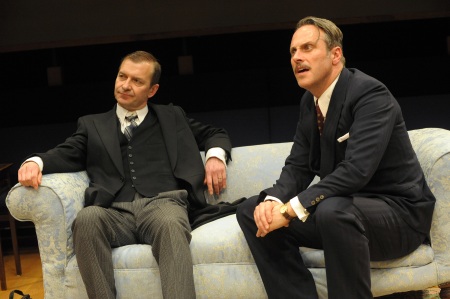
Charlie and Alfred, all images Robert Day
Maugham himself, born into a family of distinguished lawyers, opted out of a conventional life when he first decided against a legal career, and then after qualifying as a doctor he abandoned professional life for writing. In this clever play, Charlie is not a lawyer or doctor, but a stockbroker living comfortably with a wife, son and daughter in Golders Green. We also meet his close friend and solicitor named Alfred, who has a wife, son and daughter of similar ages.
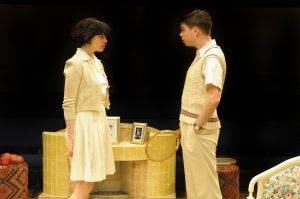
Alfred’s daughter, Charlie’s son
Auriol Smith’s well-directed revival of The Breadwinner has two intervals, and we only meet Charlie just before the first one, having already met the others. They come in various states of vacuity, though they think themselves pretty clever, thoughtful and witty, and all agree that Charlie lacks a sense of humour. In fact, Charlie is the only one who has a sense of humour — the only one who can laugh at himself.
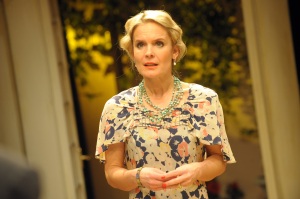
Charlie’s wife
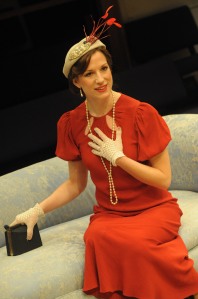
Alfred’s wife
It all starts with the four callow young people whose naïve ideas that anyone over forty is a dead loss (and it’s a good job so many of them died in the Great War) brought smiles and laughter from the audience. His son Patrick is the worst offender, a clever young man who aims for politics and wants to jump on the Labour bandwagon with no clue about life unsupported by the comforts afforded by a substantial income. But if the young ones are idiotic so are the grown-ups, with Mark Frost and Isla Carter as the bouncy good humoured Alfred and his emotionally too-clever-by-half wife, so sure that they understand what goes on in the minds of others, and Cate Debenham-Taylor so pretty as Charlie’s artistically worthy wife.
You just want someone to put these fools in their places, and Ian Targett as Charlie does it in a cleverly disingenuous way. Three women bounce off him like flies hitting a window pane, and the only person he has any sympathy for is his daughter. Perhaps he will meet her again, but you can see why Targett’s beautifully acted Charlie would be happy to get rid of the rest of them.
Performances of this satisfying production continue until May 18 — for details click here.
Tags: Auriol Smith, Cate Debenham-Taylor, Ian Targett, Isla Carter, Mark Frost, Orange Tree Theatre, review, Richmond, The Breadwinner, theatre review
Posted in Theatre | Leave a Comment »
19 April, 2013
This intriguing triple bill is the first programme artistic director Tamara Rojo has put together for the Company, and she even dances in it herself.
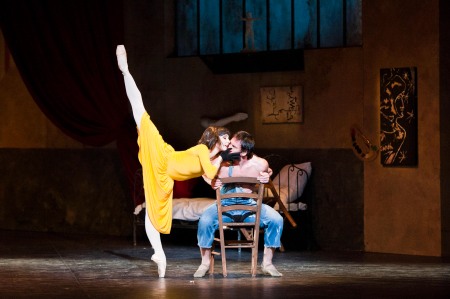
Rojo and le Riche, all images ENB/ David Jensen
The second item Le Jeune Homme et la Mort is worth the whole programme, and on the first night Rojo was the coolly callous young woman, with Nicolas le Riche, star of the Paris Opéra Ballet, as the young painter driven to madness by her strangely cold attraction. Roland Petit’s gloriously expressive choreography shows him to be in a state of nervous tension and exhaustion, and le Riche gave a riveting portrayal of his emotional despair. Two other performers will dance the role in the present run of performances, guest artist Ivan Putrov and Company member Fabian Reimair. As the girl, Tamara Rojo in her yellow dress, and later the mask of death, showed superb manipulation and indifference.
This extraordinary 1946 work, to a libretto by Jean Cocteau, formed an electrifyingly creative collaboration in post-Liberation Paris. For the music, he and Petit finally settled on Bach’s Passacaglia in C minor — at the dress rehearsal! The Bach was very strongly played under principal conductor Gavin Sutherland who gave fine musical direction to the evening, with Chris Swithinbank at the piano in Mozart’s Concertos K488 and K467 for the first item Petite Mort.
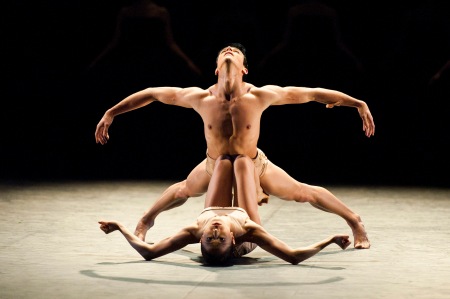
Petite Mort
The French term la petite mort is an idiomatic euphemism for sexual orgasm, and the rapiers in Jiří Kylián’s choreography suggest a dichotomy between assertiveness and oblivion for the six couples. The men performed superbly with their rapiers, setting them in motion on the stage as if moving in unison of their own accord. Excellent rehearsal preparation must have led to this precision, and the unusual and very physical choreography was crisply and energetically performed by the twelve dancers.
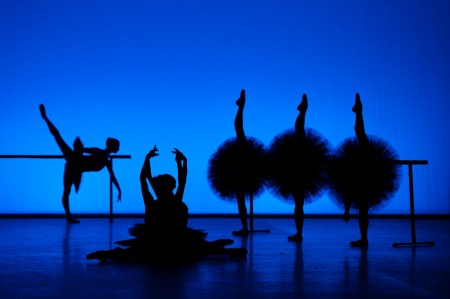
Etudes
The Company is at the top of its game, and the final Etudes was beautifully danced. Choreography is by Harald Lander, director of the Royal Danish Ballet, who created this work in 1948 to orchestral music by Knudåge Riisager, based on Czerny’s renowned piano exercises. It reveals a ballet class with a difference, as it starts with twelve girls in black tutus at the barre forming four sets of three, then three sets of four, each set in unison but different from the others. It then slowly opens out to other dancers, ending with nearly forty on stage. As the leading girl, Erina Takahashi showed lovely gentle movements, and her partners James Forbat, Esteban Berlanga and Vadim Muntagirov danced with fine precision. Muntagirov in particular showed a relaxed nobility of posture and line that was very attractive.
This triple bill shows the Company to perfection, and performances continue until April 21 — for details click here.
Tags: Bach, ballet review, Chris Swithinbank, Ecstasy and Death, ENB, English National Ballet, Erina Takahashi, Esteban Berlanga, Etudes, Gavin Sutherland, Harald Lander, James Forbat, Jean Cocteau, Jiří Kylián, Le Jeune Homme et la Mort, London Coliseum, Mozart, Nicolas le Riche, Petite Mort, review, Roland Petit, Tamara Rojo, Vadim Muntagirov
Posted in Ballet | Leave a Comment »
13 April, 2013
This new musical work by Michel van der Aa, combines film narrative and a 3D visual world behind a screen, to a libretto by novelist David Mitchell. Novels are very different from opera librettos, which must develop the characters and story in relatively few words, and part of the problem with this one is that it was difficult to care what happened to these people.
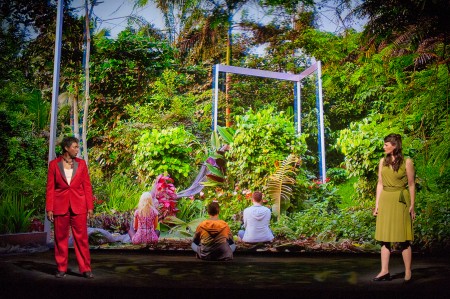
All images ENO/ Mike Hoban
There were three main ones: Toby Kramer a wannabe video artist, Zenna Briggs who pretends to want to fund his work but really wants to draw him into a strange world of disappearances, and Doctor Marinus who works in a psychiatric hospital. Roderick Williams as Toby sang with excellent diction, but the ladies with their high notes had more trouble, and were not helped by the orchestration. Surtitles were needed, and I heard the people behind me commenting afterwards that they didn’t understand what was going on. A story as strange and convoluted as this one has to be delineated very carefully to work on the opera stage, and a quick read of David Mitchell’s own synopsis hardly gives a luminous rendering of the plot.
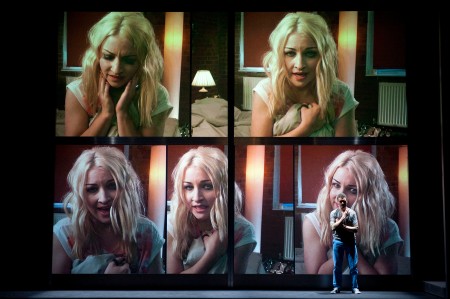
Amber
One can of course sit back and enjoy the colourful 3D garden with its vertical pool, which comes in about halfway through, but friends who were on the side upstairs evidently did not see the same effects as I did from the centre stalls. In the Garden are two lost and vanished young people, Simon and Amber, both suffering terribly from guilt, and we see on-screen interviews with his landlady and her mother before they disappeared. It turns out that they are not the only ones to suffer from psychiatric problems, but I was rather past caring by that time.
This reminded me of Judith Weir’s unsuccessful Miss Fortune at Covent Garden last year, but it does not compare with the ENO’s Two Boys, despite a preview comparison that I read. That had a compelling story; this didn’t.
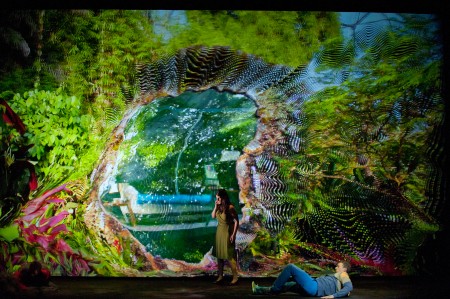
Distortion of the Garden
Katherine Manley and Claron McFadden both sang well as Zenna Briggs and Doctor Marinus, and the diction problem could and should have been solved by surtitles. Whether that would have made this rather opaque story more engaging I doubt, but it would have helped.
This ‘film opera’, co-produced by the ENO, Opéra de Lyon, Luminato Festival and Holland Festival, will doubtless attract favourable comments for the composer’s combination of music, film footage, and 3D electronic world, but the music is dull, and the libretto a serious weakness. Performances continue until April 20 — for details click here.
Tags: Barbican, Claron McFadden, David Mitchell, English National Opera, ENO, Katherine Manley, Michel van der Aa, opera review, review, Roderick Williams
Posted in Opera | Leave a Comment »
11 April, 2013
When the Rheinmaidens playfully tease Siegfried at the start of Act II, their musical movements were far better than the unmusicality of the irritatingly intrusive dancers, who reappeared in this final part of The Ring. Their manipulation of silk sheets was fine, but this is the first time I have seen opera ladies move more gracefully than dancers, which suggests Belgian director Guy Cassiers should abandon them and let Wagner’s music speak for itself.
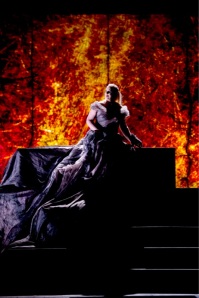
Act 1, images ©MonikaRittershaus
Under Barenboim’s direction it did so in spades, with a grippingly emotional Siegfried funeral march movingly complemented by a red glow in the lighting. But after this the production failed to carry conviction. Siegfried’s arm merely flopped to one side rather than rise in warning to Hagen, who stayed where he was before quietly leaving the stage. He suddenly returned from stage-right to shout Zurück vom Ring, before barging his way through the onlookers to get to the Rhein, but why wasn’t he anxiously waiting and following Siegfried’s body with his eyes? It didn’t make sense.
Nor did some of the video imagery of faces with tongues hanging out, but there was fine singing in abundance. Waltraud Meier, an exceptional Sieglinde in Walküre, returned to sing Second Norn with a lovely evenness of tone, and reappeared strongly as Waltraute in a well wrought conflict with Brünnhilde. Iréne Theorin was commanding in that role, singing with effortless intensity. Siegfried was boldly sung by Andreas Schager, slim, youthful and convincing, as was Mikhail Petrenko as Hagen, and Johannes Martin Kränzle reprised his deeply powerful Alberich. Anna Samuil returned from her Freia in Rheingold to sing Gutrune, and Gerd Grochowski was an immensely effective Gunther, his firm voice complementing a melancholy stage presence that reminded me of a younger Jeremy Irons. His performance was an unexpected pleasure.
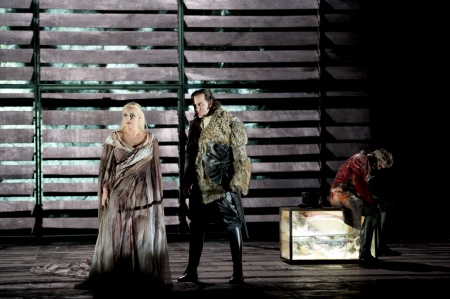
Brünnhilde, Hagen, Gunther
Overall, this production has its strong points, particularly in the lighting and some of the better video imagery, but its weakest points lie in the use of dancers. Rheingold was particularly bad in this respect, and Walküre was easily the best part, and the only one in which dancers were entirely absent. An interview in the Walküre programme showed Belgian director Guy Cassiers to have some rather naïve political ideas that included blaming Europeans for much of the poverty in the world. Perhaps his attitudes stem from Belgium’s poor colonial record, but noting that Wotan is cleverer than many of today’s politicians is a bit jejeune.
That Monsieur Cassiers is inspired by concepts relating to the interplay between good and evil, and success and failure, is no bad thing, but the unifying force that makes this Ring work so brilliantly is surely the musical direction by Daniel Barenboim. That plus a clever choice of singers who fitted their roles made this a hugely musical pleasure.
Tags: Andreas Schager, Anna Samuil, Daniel Barenboim, Götterdämmerung, Gerd Grochowski, Guy Cassiers, Iréne Theorin, Johannes Martin Kränzle, Mikhail Petrenko, opera review, review, Wagner, Wagner's Ring, Waltraud Meier
Posted in Opera, Wagner | 1 Comment »
8 April, 2013
The first two operas of this cycle experienced slight problems: orchestra lights failed a couple of times during Rheingold, and stage backdrop lighting flashed and failed in Walküre. But Siegfried saw a more serious disruption when the eponymous hero failed to show up for Act I. Why, we were not told, but the role was admirably sung from the wings by Andreas Schager, with an assistant stage manager going through the motions on stage. So vocally effective was Schager that Daniel Barenboim brought him on for a special curtain call at the end of the act, and the audience roared their appreciation.
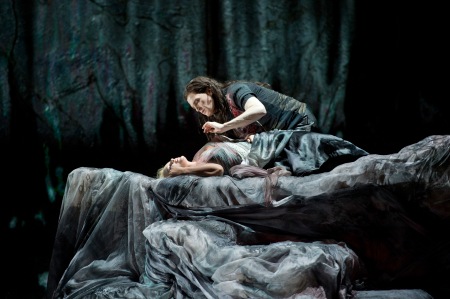
Awakening, all images © Monika Rittershaus
Canadian tenor Lance Ryan thankfully turned up for Act II, which was just as well since Schager was singing in a concert performance of Zauberflöte with the Berlin Philharmonic under Rattle later the same evening. At the end of Act II, Ryan declined a solo curtain call, and at the end of the opera, after a superb performance in Act III, the restrained applause marked audience disapproval for his early absence. But he was exceptionally good, and I regret not hearing him in all three acts. His final scene with Iréne Theorin as Brünnhilde produced glorious singing, and his Sei mein! followed by her beautifully gentle Oh Siegfried! Dein war ich von je! was a moving moment.
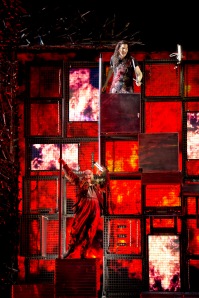
Forging the sword
Of course Daniel Barenboim in the orchestra pit was the magician bringing Wagner’s great moments to fulfilment, and this third episode of the Ring was a musical triumph. Peter Bronder sang and acted strongly as the ill-favoured Mime, and Norwegian bass-baritone Terje Stensvold gave a commanding performance as The Wanderer.
Mikhail Petrenko sang a strong Fafner from behind the stage, but here we find one of the problems in this Guy Cassiers production. The dragon was portrayed by five dancers wafting a vast printed silk sheet, but since the voice came from elsewhere this lacked conviction, and after the dragon’s death they attached themselves to Siegfried, making interminably dull geometric patterns with five swords. The dismemberment of voice and body had already occurred to the Woodbird, with a double performing insipid and unmusical movements on stage while the singing Woodbird (Rinnat Moriah, a perfectly handsome young woman) was off-stage.
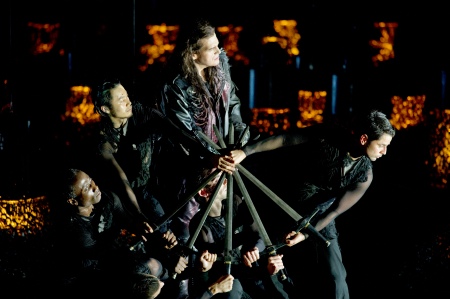
Siegfried and dancers
Good lighting and sets, except that the forging of the sword was essentially done by atmospheric lighting and seven flat screen videos, plus a few tap-taps in the upstairs part of the set, as if a saucepan were being mended. Otherwise I liked the intriguing design for Mime’s home, which Wotan navigated with admirable aplomb as it turned from horizontal to vertical. Forest lighting was wonderful, and the meeting of Alberich and the Wanderer in Act II was very effective. If the superfluously irritating dancers had been absent, this act would have been perfect — they were not there in Walküre, and I’m sure most of us hope for the same with Götterdämmerung.
This performance was on April 7, and the final instalment of The Ring takes place on April 10.
Tags: Andreas Schager, Guy Cassiers, Iréne Theorin, Lance Ryan, Mikhail Petrenko, opera review, Peter Bronder, review, Siegfried, Staatsoper-Berlin, Terje Stensvold, Wagner, Wagner's Ring
Posted in Opera, Wagner | 2 Comments »
6 April, 2013
What a spectacular ending to Act III this was, equalled in my recent memory only with Barenboim in the same production at La Scala in December 2010.
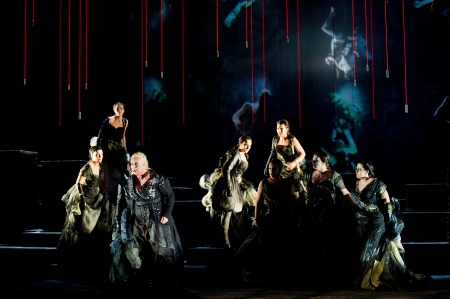
All images © Monika Rittershaus
His sensitive handling of the orchestra framed those hugely gentle scenes between the sympathetic Wotan of René Pape and the intensity of Iréne Theorin as his daughter Brünnhilde, when for example when he tells her she is the daughter of the world’s wisest woman, and later when she coaxes him away from consigning her to a fate worse than death. These were tranquil and beautiful moments, as was the encounter between Brünnhilde and the noble Siegmund of Peter Seiffert when she announces his impending doom.
Yet all the singers came over with great force at times of high drama. Peter Seiffert’s cry to his lost father, Wälse! Wälse! in Act I had huge lyrical force, with the orchestra at full tilt, and Waltraud Meier gave Sieglinde a sublime intensity after Brünnhilde dissuades her from death by telling of a Wälsung in her womb. Rette mich Kühne! (Rescue me brave one) had tremendous lyrical force, and when Brünnhilde gives her the shards of the sword, and names him Siegfried, O hehrstes Wunder floated high above the orchestra, ascending to the gods themselves.
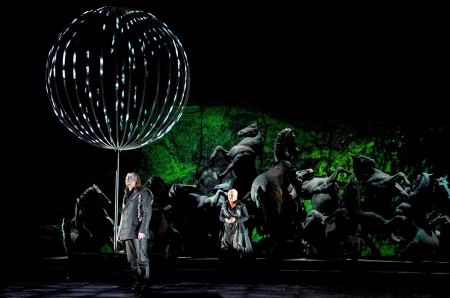
Wotan and Brünnhilde
These great turning points in The Ring are powered by forces that Wagner extracts from deep mines of cultural history, but he sets it all going in dramatic style with that wonderful Act I. Here Seiffert and Meier beautifully vocalised their mutual passion, and the strongly youthful Hunding of Mikhail Petrenko represented the determined world of honour killing, supported by the fiery Fricka of Ekaterina Gubanova. And when Hunding kills Siegmund in Act II he does not merely fell him with a sword, but thrusts a spear through his body as it lies on the ground.
As he stands victorious on stage-right, Wotan on stage-left quietly commands him to kneel before Fricka. He remains motionless, and as Pape firmly emphasises the second Geh! he falls dead. Earlier in Act II, Pape showed utter exhaustion after telling Fricka she could take his oath, and his beautifully crafted portrayal of Wotan’s self awareness allowed him to project huge power in the final moments of Act III. As the music crescendos, his Leb’ wohl! to Brünnhilde swept with huge power through the orchestral sound.
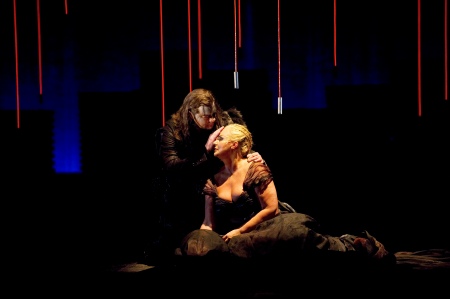
Wotan’s farewell to Brünnhilde
After the final bars the audience gradually recovered from the magic, and the sustained applause took in more than one appearance on stage by the full orchestra, and numerous curtain calls for Barenboim and the soloists, including the Walküren in their voluminous dresses. Immensely cumbersome though Tim Van Steenbergen’s costumes may be, they are effective, as is this whole production by Guy Cassiers with lighting and assistance on set design by Enrico Bagnoli. Thank goodness the dancers from Rheingold were entirely absent, leaving us to savour the heart and soul of the music.
This performance was on April 5, and Siegfried continues on April 7.
Tags: Daniel Barenboim, Ekaterina Gubanova, Enrico Bagnoli, Guy Cassiers, Iréne Theorin, Mikhail Petrenko, opera review, Peter Seiffert, René Pape, review, Tim Van Steenbergen, Wagner, Wagner's Ring, Waltraud Meier
Posted in Opera, Wagner | 2 Comments »
5 April, 2013
The lights went down and all was silence. In the partially covered pit the conductor was invisible but slowly a quiet E flat emerged. Daniel Barenboim’s restrained conducting allowed huge clarity for the singers and plenty of scope for the brass at big moments. It was a coolly intriguing prelude to The Ring.
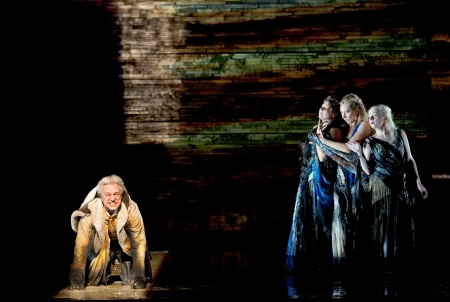
Alberich and Rheinmaidens, all images ©Monika Rittershaus
The stage was filled with water, albeit shallow, and Alberich and the Rheinmaidens were like a boy with three teasing girls splashing around in the water. After their mockery he is defeated and soaking wet. Then comes the gold motif and we’re off and away.
After Alberich takes the gold, dancers enter. They form everything from an arch for the entrance of Wotan and Fricka, to a throne for Alberich and an animated tarnhelm. They also writhe and express themselves to the music, but not everyone will like this aspect. Some of us prefer less distraction. It seems that the director, Guy Cassiers is keen to see perpetual motion on stage, whereas many in the Wagner audience are doubtless more keen to listen to the orchestral sound and the singers.
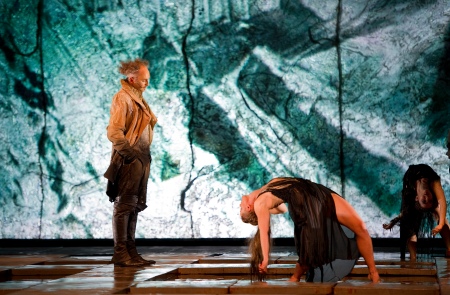
Loge and dancers
In this respect there was some very fine singing indeed. Johannes Martin Kränzle was a terrific Alberich, somewhat hampered by the dancers in this opera, and I look forward to his return in Siegfried and Götterdämmerung. Superb diction and tone from Iain Paterson and Mikhail Petrenko as Fasolt and Fafner, plus a very strong vocal presence by Stephan Rügamer as Loge, and mellow attractiveness from Ekaterina Gubanova as Fricka. Despite a subdued performance as Wotan, René Pape came through strongly when necessary, particularly after taking the Ring from Alberich when he gloats that his new possession will raise him to der Mächtigen mächtigsten Herrn (the mightiest of mighty lords).
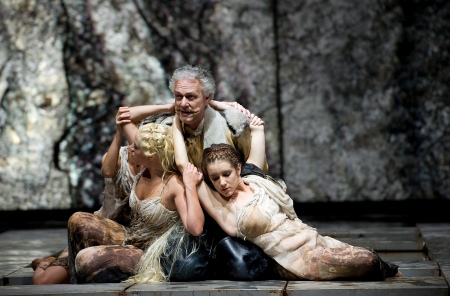
Alberich and dancers
The Ring itself in this production is a sparkling glove, and when Alberich loses it the end of his arm appears cut off. The glove idea has the merit of making the Ring obviously visible to the whole audience, and when Wotan heeded Erda’s warning he gave it up by simply tossing it over his head.
Costumes by Tim Van Steenbergen put the giants in dark suits, and the representation of the male gods reminded me of some rather odd dictators (the late Kim Jong Il came to mind in the person of Donner), and British readers will know what I mean if compare the appearance of Loge to violinist Nigel Kennedy.
Good lighting by Enrico Bagnoli, who collaborated with director Guy Cassiers on the sets, and I liked the video projections that at one point seemed to suggest a future world. Their reflection on the water was very effective, but I gather from friends that this was not visible from all parts of the auditorium.
This performance was on April 4. Die Walküre continues tonight on April 5, unencumbered by dancers if my memory of La Scala serves me right.
Tags: Berlin, Daniel Barenboim, Ekaterina Gubanova, Enrico Bagnoli, Guy Cassiers, Iain Paterson, Johannes Martin Kränzle, Mikhail Petrenko, opera review, René Pape, review, Rheingold, Staatsoper-Berlin, The Ring, Tim Van Steenbergen, Wagner's Ring
Posted in Opera, Wagner | 4 Comments »
3 April, 2013
Soviet Realism meets Don Quixote, with the good Don replaced by an evil Commander whom the peasants destroy. He abducts the beautiful Laurencia, imprisoning her lover Frondoso, and there is a nasty sexual assault by two soldiers on a peasant named Jacinta. The women are both badly used and emerge with dirty torn skirts, but there is plenty of wonderfully happy dancing by the peasants, choreographed by famous Georgian dancer and choreographer Vakhtang Chabukiani.
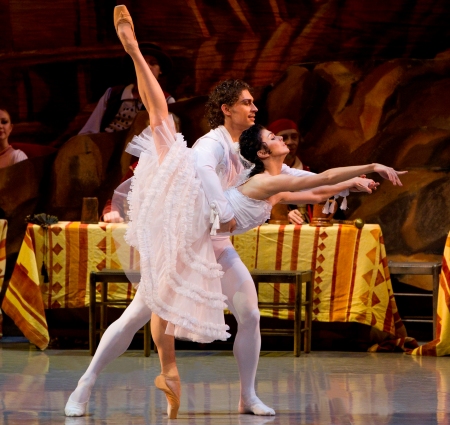
Frondoso and Laurencia, all images ©MikhailovskyTheatre
As a powerful presence on stage himself, he wrote steps for a strong male dancer in the leading role of Frondoso, and Ivan Vasiliev made the most of it. With his extraordinary ability to perform multiple pirouettes that slow down and come to a perfect stop, his brilliant leaps en tournant, and his fine stage presence, Vasiliev was well matched by the technical brilliance and musicality of Natalia Osipova. Did I see a quadruple fouetté en tournant? Certainly there were some triples, but it is her dramatic commitment and attention to detail that make her so exciting to watch. The two of them together are a marvel.
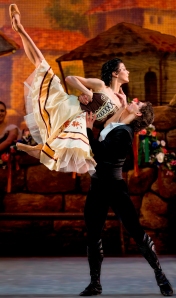 Yet the whole company gave this huge sparkle, and Sabina Yapparova as Pasquala was a delight. It was she and Osipova who cleverly scuttled away from the soldiers in Act I, and her classical dancing in Act II, when the village celebrates the union of Laurencia and Frondoso, was outstanding. At the other end of the pleasantry spectrum, Mikhail Venshchikov portrayed the Commander as a thoroughly nasty piece of work, and he stayed in character for the curtain calls to receive the welcoming boos.
If you want to see an old Soviet ballet, this one from 1939 is well worth the ticket, and if you want to see some spectacular male dancing this is a must-see, with Vasiliev and Osipova giving a second performance on April 3. Set and costume designs by Vadim Ryndin are lovely, and Valery Ovsyanikov in the orchestra pit gave a strong impetus to Alexander Krein’s music. This composer seems to have adapted rather well to the Soviet system, and his music serves its purpose, but the reason to go to this, and it’s an excellent reason, is to see Chabukiani’s choreography performed with enormous panache.
Following a second performance of Laurencia with Osipova and Vasiliev on April 3, the Mikhailovsky Ballet will perform other productions until April 7 — for details click here.
Tags: Alexander Krein, ballet review, Ivan Vasiliev, Laurencia, London Coliseum, Mikhail Venshchikov, Mikhailovsky Ballet, Natalia Osipova, review, Sabina Yapparova, Vadim Ryndin, Vakhtang Chabukiani, Valery Ovsyanikov
Posted in Ballet | Leave a Comment »
1 April, 2013
For classical ballet in glorious costumes with plenty of bouncy music it is hard to equal Don Quixote, and the Mikhailovsky Ballet did us proud with the feast they served up at the London Coliseum. The feel-good music by Minkus, plus some additions by Drigo, is a favourite of pianists in ballet class, and Lanchbery used parts of it in Tales of Beatrix Potter.
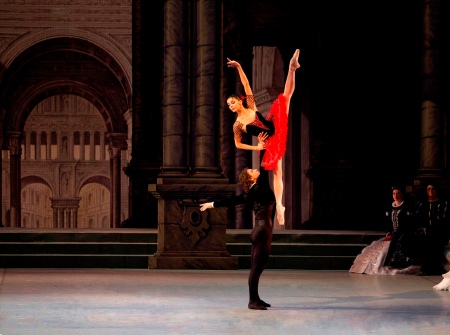
Osipova and Vasiliev, all images © Mikhailovsky Theatre
This dance-pantomime is not a recent favourite of British companies, though Carlos Acosta is staging a new version for the Royal Ballet in October 2013. That aside we have tended to rely on the Russians to bring it over, and they never fail to please. Originally created by Minkus and Petipa for Moscow in 1869, they expanded it for St. Petersburg two years later, and in 1900 and 1902 Alexander Gorsky restaged it in both cities. What we see here is due to Petipa and Gorsky.
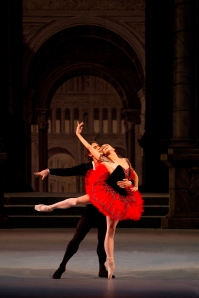 The whole company gave a vivid portrayal of the choreography, led by the peerless Natalia Osipova as Kitri, who doesn’t merely use the music as background but feels it in all the small movements of her body. Ivan Vasiliev as her lover Basilio showed sensational leaps en tournant, hugely dramatic if sometimes untidy and his smaller jumps sometimes lacked classical poise. His strong partnering allowed him to perform an arabesque while holding her up with one hand, the orchestra falling silent for effect, and when they enter the tavern and he catches her as she flies horizontally through the air, he almost allows her head to sweep the floor. Wonderful fun.
Excellent solos from other dancers such as Nikolay Korypayev as the toreador, and Veronica Ignatyeva as Cupid in the dream scene. This white section, where Quixote dreams of his beloved Dulcinea in her enchanted garden of dryads, was beautifully performed and Natalia Osipova as Dulcinea was a delight.
Her exemplary dancing and musicality raised this joyous 2012 production to a seriously high level, and the Company responded in superb style. The glorious set and costume designs by Vyacheslav Okunev even had a horse and pony for the entrance of Don Quixote and Sancho Panza in Act I. No expense spared, and the Mikhailovsky orchestra conducted by music director Pavel Bubelnikov played with great panache.
This London visit of the Mikhailovsky Ballet is a treat, and I look forward to their production of Laurencia on April 2. A Soviet era ballet, first danced by the Kirov in 1939, this is a village love story with a peasant rebellion against the wicked Commander who abducts the girl and imprisons her lover.
Performances of Laurencia take place on April 2 and 3, followed by other productions until April 7 — for details click here.
Tags: Alexander Gorsky, ballet review, Don Quixote, Drigo, Ivan Vasiliev, London Coliseum, Mikhailovsky Ballet, Minkus, Natalia Osipova, Nikolay Korypayev, Pavel Bubelnikov, Petipa, review, Veronica Ignatyeva, Vyacheslav Okunev
Posted in Ballet, Don Quixote | Leave a Comment »
31 March, 2013
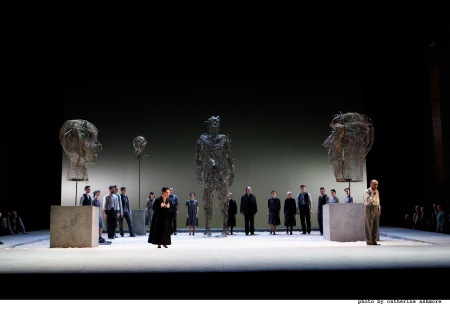
After Verdi’s dissatisfaction with his second opera he nearly gave up, but thank goodness he didn’t because this third one is magnificent, apart from its rather weak ending. Placing the action in the 1940s rather than the original setting of 586 BC is a good idea, but it never really gelled and I found Daniele Abbado’s new production disappointing.
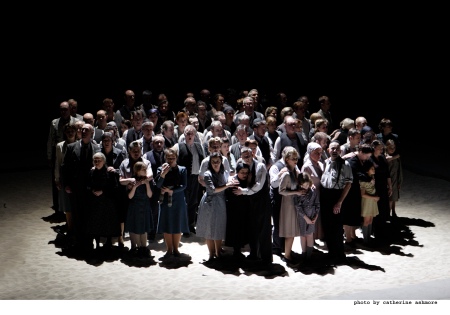
Va pensiero
The singing however was quite another matter. Ukrainian soprano Liudmyla Monastyrska was spectacular as Nabucco’s adopted daughter Abigail. Covent Garden audiences who remember her terrific Lady Macbeth from June 2011 will know what to expect, and she certainly provided it, giving huge colour to a bland production. Her recitative, aria and cabaletta at the start of Act II were riveting — her voice so expressive and powerful.
Her fellow Ukrainian, Vitalij Kowljow brought a full rich tone to the bass role of the Hebrew high priest Zaccaria, and Italian tenor Andrea Caré sang beautifully in the tenor role of Ismaele who is loved by both Abigail and her half-sister Fenena. Ismaele loves Fenena and although the heavy presence of Marianna Pizzolato in that role was rather lifeless, she sang with a lovely clarity of tone.
Conducting by Nicola Luisotti showed great attention to the singers, and the chorus sang superbly, with a lovely Va pensiero in Act III. Leo Nucci as Nabucco showed very well the confusion that Solera’s libretto gives him after he calls himself a god, and then produced a glorious Act IV aria accepting the God of Israel. The cello solo when Abigail shows remorse was beautifully played, and Luisotti produced fine musicianship from the orchestra.
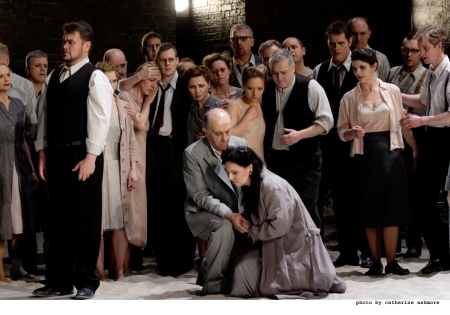
Zaccaria, Nabucco, Abigail
From the Amphitheatre the movements of the chorus looked rather contrived, with one group of people waiting to move forward before another group moved aside, though it may have appeared more natural from lower in the House. And the video projections were not fully visible from the front row of the Amphi rendering them only partially visible to nearly half the audience — no wonder it was not liked from the greater heights of La Scala. The fact that it’s a co-production with Milan, Barcelona and Chicago doesn’t surprise me in these days of austerity, but if resources are scarce perhaps we should leave such minimalist new productions to the English National Opera, with Covent Garden concentrating on bringing in world class singers, which they have done here to great effect.
Performances with this cast continue until April 8, and from April 15 to 26, Domingo takes over from Nucci — for details click here. On April 29 there will be a delayed live cinema screening, and it will be broadcast on BBC Radio 3 on June 8 at 6pm.
Tags: Andrea Caré, Covent Garden, Daniele Abbado, Leo Nucci, Liudmyla Monastyrska, Marianna Pizzolato, Nabucco, Nicola Luisotti, opera review, review, Royal Opera, Verdi, Vitalij Kowaljow
Posted in Opera, Verdi | 1 Comment »


 Mark Ronan's Theatre Reviews